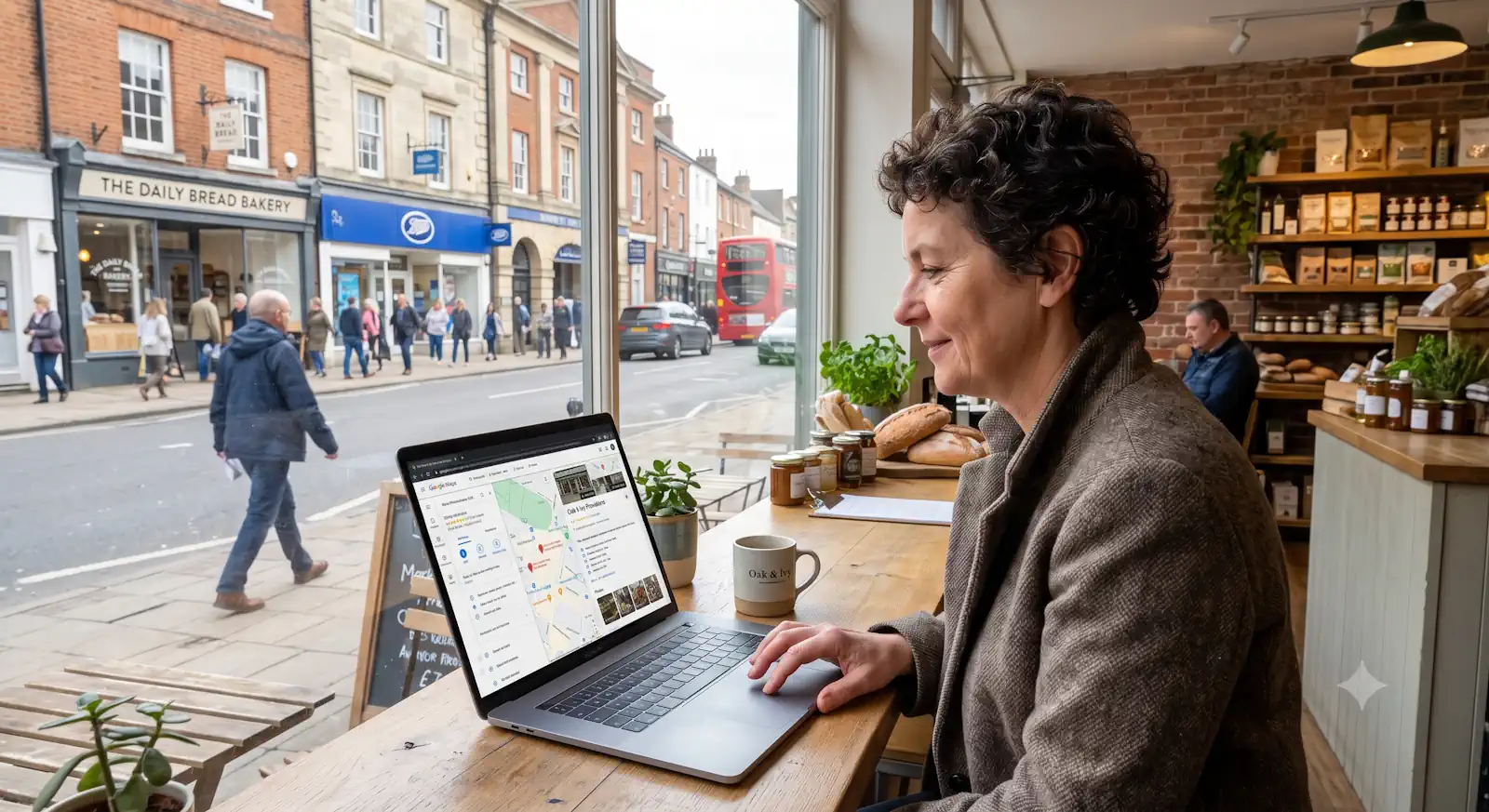
Many local business owners assume larger companies have the advantage on Google Maps because they have bigger budgets, more staff and more time to spend on marketing. In some parts of online marketing that can be true. But local search is different.
Google Maps is not only trying to show the biggest business. It is trying to show a useful local result for the person searching. That means a well-managed small business can often compete strongly, especially when it is clear about where it works, what it does and why customers trust it.
For a plumber, dental practice, hair salon, accountant, garage, café, cleaner or tradesperson, this matters. People searching on Google Maps are often close to making a decision. They may need directions, opening hours, a phone number, photos, reviews or reassurance that the business is active and reliable.
The opportunity for small businesses is not about tricks. It is about doing the basics properly, keeping information up to date and showing local relevance in a way that both customers and Google can understand.
Why small businesses can perform well locally
Large brands often have strong websites and national recognition, but they are not always as closely connected to a specific town, village or service area. A local business can be more precise.
You know the areas you serve. You know the common questions customers ask. You know the landmarks, nearby places, seasonal issues and practical details that matter in your location. When this local knowledge is reflected across your Google Business Profile, website and customer reviews, it can help build a stronger local picture.
Google looks at several signals when deciding which local results to show. These include relevance, distance and prominence. A small business cannot control every factor, but it can improve many of the signals that help Google understand it.
For example, a business with a complete profile, accurate categories, regular photos, clear services and steady reviews may appear more useful than a larger competitor with a neglected listing. This is where small businesses often have the edge: they can be more responsive, more personal and more specific.
Start with a complete and accurate Google Business Profile
Your Google Business Profile is one of the main foundations of your visibility in Google Maps. It should not be treated as a one-off listing that is set up and forgotten.
Check that your business name is correct, your phone number works, your address or service area is accurate and your opening hours are up to date. If you close for bank holidays, staff training or seasonal breaks, update those hours too. Small details can affect whether a customer chooses you or moves on to another result.
Your primary category is especially important. It should describe what your business mainly is, not every service you would like to be found for. Secondary categories can then support the wider picture. If you are unsure whether your profile is set up correctly, professional Google Business Profile support can help you review the structure and spot missed opportunities.
Business descriptions should be written for people first. Explain what you do, who you help and where you work. Avoid stuffing in repeated place names or service phrases. A natural, clear description is more useful than a block of forced keywords.
Show real local activity
Google Maps visibility is helped by signs that a business is active and useful. This does not mean you need to post every day or turn your profile into a social media feed. It means keeping your presence alive and accurate.
Photos are a simple place to start. Add real images of your premises, team, vehicles, completed work, products or treatment rooms. For service businesses, before-and-after images can be useful if they are appropriate and you have permission. For customer-facing businesses, photos can remove uncertainty before someone visits.
Updates can also help. You might mention a new service, a seasonal reminder, a change in opening hours, a local project or a useful customer question. The aim is to show that your business is current and engaged.
Reviews are another key part of local activity. A small business often has direct relationships with customers, which makes it easier to ask for honest feedback. You should not pressure people or offer rewards for reviews, but you can make the process simple by asking at the right time and explaining that reviews help local customers choose with confidence.
Use reviews to build trust, not just numbers
Many business owners focus only on the number of reviews. Numbers do matter, but the quality and detail of reviews can be just as helpful. A short review saying “great service” is positive, but a detailed review explaining the job, location and experience gives more context.
Encourage customers to describe what they genuinely valued. For example, they might mention punctuality, clear communication, tidy work, friendly staff, quick booking, a specific treatment or a product they bought. These details help future customers understand what to expect.
Replying to reviews is also worthwhile. Keep replies polite, brief and specific where possible. Thank the customer, acknowledge the service and avoid sharing private details. A considered reply shows that the business is attentive.
Negative reviews should be handled calmly. Do not argue publicly. A measured response can reassure future readers, even if the original review is unfair. For local businesses, the way you respond is part of your public reputation.
Make your website support your Maps visibility
Your Google Business Profile and website should work together. If your profile says one thing and your website says another, it creates confusion. Consistency helps both users and search engines.
Your website should clearly show your services, location, contact details and opening hours. If you serve multiple nearby towns, create genuinely useful content for those areas rather than copying the same page and changing the place name. Explain what you do in each area, any practical details customers need to know and examples of relevant work where appropriate.
A local business website does not need to be complicated, but it does need to be clear. Visitors should quickly understand whether you can help them, where you operate and how to contact you. If the website is slow, vague or difficult to use on a mobile phone, it can weaken the customer journey after someone finds you on Maps.
If you are not sure how your Maps listing, website and local search presence fit together, a Local Visibility Check can help identify the main gaps before you spend time changing the wrong things.
Think like a nearby customer
A useful way to improve your local presence is to step back and think like someone searching from their phone. They are unlikely to read everything in detail. They want fast reassurance.
They may ask themselves: Are you open? Are you near enough? Do you offer what I need? Do you look trustworthy? Can I call you easily? Do your reviews sound genuine? Are your photos current? Does your website confirm the same information?
Every part of your local visibility should help answer these questions. That includes your Google Business Profile, website, reviews, photos, services and contact options.
Small businesses often do this well because they understand their customers personally. The challenge is making sure that understanding is visible online.
This article is based on the ideas discussed in the embedded video, with added UK local business context and practical guidance for business owners.
Avoid common Google Maps mistakes
Some local businesses lose visibility because of simple mistakes. These are often easy to fix once noticed.
- Out-of-date opening hours: This can frustrate customers and reduce trust.
- Wrong categories: If your main category is too broad or inaccurate, Google may misunderstand your business.
- Thin service information: Listing only one or two services may hide the full range of what you offer.
- No recent photos: An inactive-looking profile can make customers uncertain.
- Ignoring reviews: Lack of replies may make the business appear less engaged.
- Inconsistent contact details: Different phone numbers, addresses or names across the web can cause confusion.
- Over-optimised wording: Repeating keywords unnaturally can look poor to customers and is not a sound long-term approach.
Improvement usually comes from steady housekeeping rather than dramatic changes. A well-maintained profile is easier for customers to trust.
Local relevance is built over time
Google Maps visibility is not usually improved by one single action. It is built through a combination of accurate data, useful content, local relevance, customer feedback and ongoing care.
This is good news for small businesses because much of it is within reach. You do not need to become a technical expert, but you do need a clear process. Set a regular time to check your profile, add useful photos, review your services, reply to customers and make sure your website still reflects what you offer.
You can also look at how your business appears from different customer viewpoints. Search for your main service, your business name and common local phrases. Check what appears in Google Maps and whether your listing gives enough confidence compared with others nearby. For broader help with map performance, see Google Maps visibility.
It is also worth remembering that AI search tools increasingly draw on clear business information from across the web. A complete, consistent and well-explained local presence may help your business be understood more easily beyond traditional search results.
What to focus on next
If you want better visibility in Google Maps, start with the areas that are most likely to help customers make a decision.
- Check your Google Business Profile details are accurate.
- Review your primary and secondary categories.
- Add or improve your services and business description.
- Upload recent, genuine photos.
- Ask satisfied customers for honest reviews.
- Reply to reviews in a calm and professional way.
- Make sure your website confirms your services, location and contact details.
- Review your profile regularly rather than leaving it untouched.
The advantage small businesses have is not that Google favours them automatically. It is that local businesses can be more relevant, more specific and more human than larger competitors. When that is reflected clearly online, it can make a real difference to how customers find and choose you.
Google Maps visibility rewards clarity. If your business is easy to understand, easy to contact and clearly trusted by local customers, you are giving both Google and potential customers better reasons to consider you.