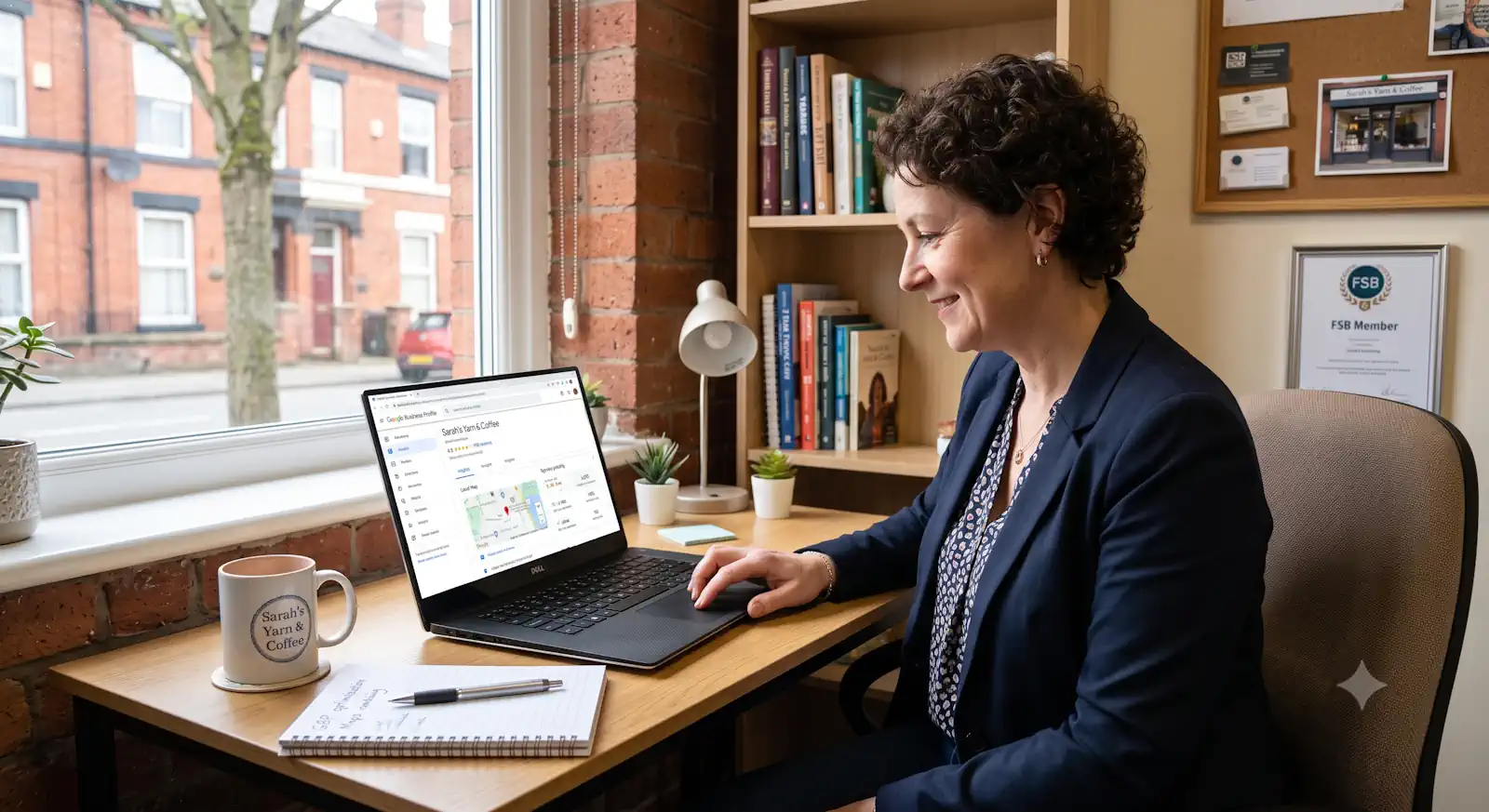
For many UK local businesses, Google Business Profile is one of the first places a potential customer sees you. It may appear before your website, before your social media, and sometimes before they even know your business name. That makes it important, but it does not mean it needs to be complicated.
Improving visibility is usually not about one clever trick. It is about helping Google understand what you do, where you do it, who you help, and why your business is a reliable option. When those signals are clear and consistent, your profile has a better chance of appearing for relevant local searches.
This article sets out a practical method for strengthening your Google Business Profile visibility. It is written for local business owners who want sensible actions rather than vague advice or promises. You can apply the ideas whether you run a service business, a shop, a clinic, a trade business, a professional practice, or another local organisation.
Start with the searches that actually matter
A common mistake is trying to show up for every possible phrase. That usually leads to weak wording, unfocused content, and frustration. A better starting point is to decide which searches would genuinely bring the right customers.
Think about what your best customers would type or say into Google. For example, they might search for a service plus a town, a problem plus a local area, or a product near them. A plumber, solicitor, beauty clinic, accountant, dog groomer, roofer, or independent retailer will all have different valuable searches.
Write down a short list of the main services or products you want to be known for. Then add the towns, villages, suburbs, or areas you realistically serve. This gives you a useful visibility map. It also stops you from filling your profile with broad phrases that do not reflect your real business.
If you are unsure where you currently stand, a Local Visibility Check can help you see how your business appears across local search results and where the main gaps may be.
Make your profile easy for Google and customers to understand
Your Google Business Profile should answer the basic questions quickly. What do you do? Where are you based? Who do you serve? How can someone contact you? What makes your services suitable for their needs?
Start with the foundations. Check that your business name is accurate and matches your real-world branding. Avoid adding extra words purely to chase rankings. Choose the most accurate primary category, then add relevant secondary categories if they truly apply. Your categories are one of the clearest ways to tell Google what your business is about.
Your address, phone number, opening hours, website link, service areas, appointment options, and business description should all be current. If your hours change for bank holidays or seasonal periods, update them. Customers notice these details, and incorrect information can damage trust before anyone contacts you.
Your description should be clear rather than stuffed with phrases. Explain your main services, your local area, and the type of customers you help. For many businesses, a plain sentence such as we provide boiler servicing and heating repairs for homeowners and landlords in Exeter and nearby villages is more useful than a long block of repeated keywords.
If you need help getting the basics right, the Google Business Profile support page explains how a structured approach can improve the quality and consistency of your profile.
Build relevance around your main services
Google needs evidence that your business is relevant to the searches you want to appear for. Your profile alone can help, but it works best when it is supported by useful information elsewhere.
Use your products or services section properly if it is available for your type of business. Add your main services with short, helpful descriptions. Do not list every tiny variation if it makes the profile messy. Focus on the services customers actually ask for and the ones you want more enquiries about.
Photos can also support relevance. Add real images of your premises, team, vehicles, equipment, completed work, displays, treatment rooms, or products. For service businesses, before-and-after examples can be useful where appropriate and compliant with your industry rules. Avoid relying only on stock images, as they do little to prove your local presence.
Your website should reinforce the same themes. If your profile says you offer a service in a certain area, your website should provide useful detail about that service and the areas you cover. This does not mean creating thin pages for every nearby town. It means making your main services clear and giving visitors enough information to make a decision.
Use reviews as real evidence, not just a number
Reviews are often treated as a numbers game, but the words inside reviews can be just as important. A review that mentions the service, location, problem solved, or customer experience gives both people and search systems more context.
You should not script customer reviews or pressure people. However, you can make it easier for customers to leave useful feedback. When asking for a review, you might politely say that it helps if they mention the service they used and their experience. Keep it honest and simple.
Reply to reviews in a natural way. Thank the customer, refer briefly to the service if appropriate, and keep the response professional. Avoid copying and pasting the same reply every time. A considered response shows potential customers that the business is active and attentive.
Negative reviews should also be handled calmly. Do not argue publicly. Acknowledge the concern, explain that you are happy to discuss it, and move the conversation offline where possible. A sensible response can reassure future customers even when a review is not ideal.
Show activity without posting for the sake of it
An active profile can help customers see that your business is open, current, and engaged. That does not mean you need to post every day or treat Google Business Profile like a social media feed.
Useful updates might include seasonal services, new opening hours, recent work, helpful reminders, new products, team updates, or answers to common customer questions. A garage might post about winter vehicle checks. A clinic might explain how to prepare for an appointment. A restaurant might share a new menu. A tradesperson might show a recent project with a short explanation.
The key is usefulness. If a post would help a potential customer understand your service, it is probably worth publishing. If it is only there to fill space, it is less likely to help.
Questions and answers are also worth checking. Customers may ask questions directly on your profile. Answer them clearly. You can also add common questions yourself, provided the answers are genuine and helpful. This is particularly useful for pricing approach, parking, booking, service areas, accessibility, delivery, emergency work, or appointment requirements.
For businesses that rely heavily on map results, it is also worth reviewing your wider Google Maps visibility, as Maps performance can be affected by proximity, relevance, profile quality, and local competition.
This article is based on the ideas discussed in the embedded video, with added UK local business context and practical guidance for business owners.
Strengthen the trust signals around your business
Google Business Profile does not exist in isolation. Your visibility is influenced by the broader picture of your business online. If your details are inconsistent, your website is unclear, or your business is hard to verify, it can weaken confidence.
Check that your name, address, phone number, and website are consistent on your website, main directories, industry listings, social profiles, and local business pages. Small differences are not always a problem, but outdated numbers, old addresses, or duplicate listings can cause confusion.
Your website should make the same details easy to find. Include a clear contact page, visible phone number, service information, location information, and trust indicators such as qualifications, memberships, case studies, testimonials, or guarantees where relevant. These should be truthful and specific.
Local links and mentions can also help build trust. These might come from suppliers, local organisations, sponsorships, community groups, local press, trade bodies, or business associations. The aim is not to collect links for the sake of it. The aim is to build a credible local footprint that reflects your real activity.
Pay attention to behaviour after people find you
Visibility is useful only if it leads to the right actions. Your profile should make it easy for someone to call, book, visit, ask a question, or click through to your website. If people find you but do not take the next step, the problem may be clarity rather than visibility.
Look at your profile from a customer’s point of view. Is it obvious what you offer? Are the photos recent? Are the reviews credible? Does the website page you link to match the service they were looking for? Is your phone number easy to use on mobile?
Many local searches happen on phones, often while someone is ready to act. A slow, confusing, or outdated website can waste the opportunity created by a good profile. Make sure your landing page supports the same message as your Google Business Profile.
It is also sensible to track enquiry quality, not only enquiry volume. More calls are not always better if they are for the wrong service or outside your area. Over time, refine your profile, website content, and service descriptions around the enquiries you actually want.
Create a simple monthly routine
The businesses that improve steadily are often the ones that maintain their profile consistently. You do not need to spend hours each week. A simple monthly routine can make a real difference.
- Check your opening hours, contact details, and website link.
- Add one or two useful photos from recent work or business activity.
- Publish a practical update if you have something helpful to share.
- Ask recent happy customers for honest reviews.
- Reply to new reviews and questions.
- Review which services or areas are generating good enquiries.
- Check that your website still supports your main services clearly.
This kind of routine keeps your profile accurate and gives Google fresh, relevant signals. It also helps customers feel confident that the business is active and reliable.
A practical method beats guesswork
Improving Google Business Profile visibility is not about chasing every new tactic. It is about getting the important elements right and maintaining them over time. Clear categories, accurate information, relevant services, real photos, useful reviews, consistent business details, and a helpful website all work together.
For UK local businesses, the best approach is usually steady and practical. Focus on the searches that matter, show real evidence of what you do, keep your information current, and make it easy for customers to take the next step.
If your profile has been left untouched for a while, start with the basics. Then build relevance and trust month by month. Small improvements, made consistently, are often more useful than a one-off burst of activity followed by months of neglect.