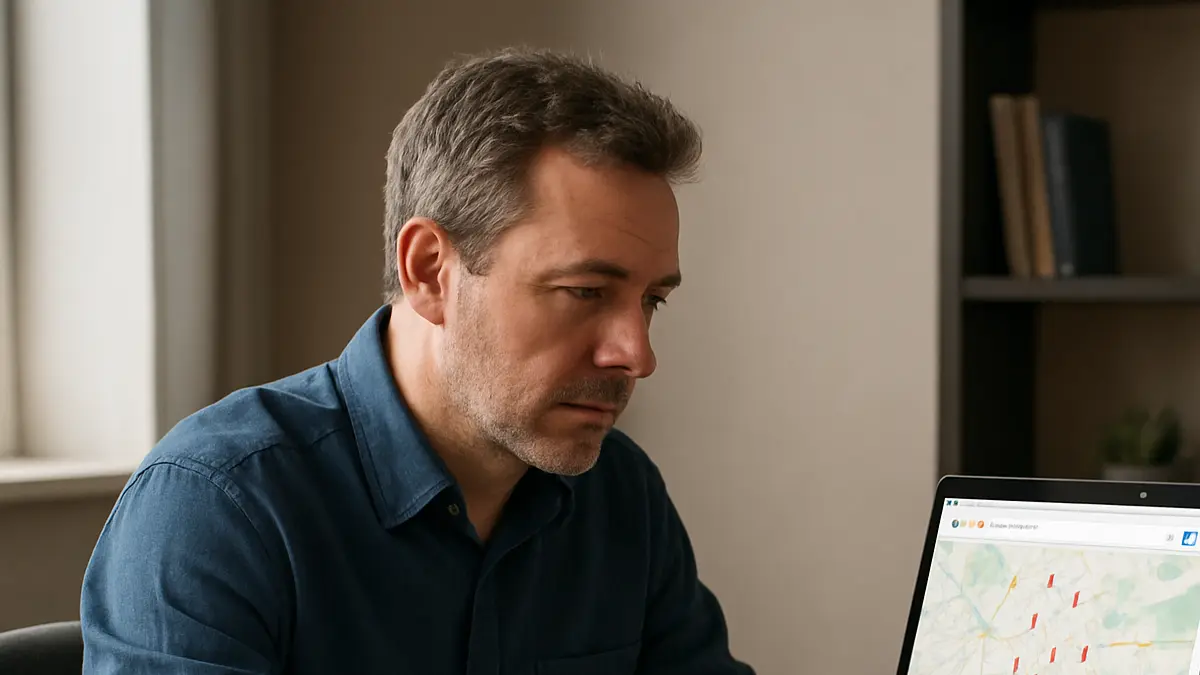
Many local business owners check Google Maps, see their business somewhere on the results, and assume things are more or less fine. The problem is that visibility is not just about appearing. It is about whether the right customers see you, trust you, and take action.
If calls have slowed down, the cause is not always the economy, seasonality, or competitors spending more on adverts. Sometimes the issue is quieter. Your Google Business Profile may be showing in weaker positions, appearing for the wrong searches, lacking the right information, or failing to give people enough confidence to call.
This article gives you a practical way to look at your Google Maps presence through the eyes of a potential customer. It is written for UK local businesses that rely on calls, enquiries, bookings, visits, and service area leads.
Being visible is not the same as being chosen
A business can appear on Google Maps and still lose enquiries. This happens because customers do not judge you on one factor. They look at your position, business name, review score, number of reviews, photos, services, opening hours, location, and whether your profile feels current.
For example, a plumber in Exeter, a roofer in Plymouth, or a decorator in Torquay may all appear in local results. But if one profile has clear services, recent reviews, helpful photos, and sensible opening hours, it may attract more calls than another profile sitting nearby.
This is why local visibility needs to be reviewed as a whole. Ranking matters, but it works alongside relevance and trust. If your profile does not match what customers are searching for, or if it looks neglected, a higher position may still produce fewer calls than expected.
If you want to understand this wider picture, the Google Maps Visibility page explains how Maps performance fits into local customer behaviour.
Start your audit with real customer searches
The first mistake many business owners make is searching only for their own business name. That tells you whether people can find you when they already know you. It does not tell you whether new customers are finding you when they need your service.
Use searches that a normal customer might type or say, such as:
- emergency electrician near me
- boiler repair in Bristol
- roof repairs near Barnstaple
- accountant for small business in Taunton
- dog groomer near me
Carry out these checks from your local area if possible. Google Maps results can change depending on where the searcher is, so a result from your office may not match what someone sees five miles away. If you serve several towns, check each main area separately.
Do not only record whether you are first, second, or third. Make notes on who appears around you. Look at their review numbers, categories, photos, descriptions, services, and how complete their profiles look. The aim is not to copy them, but to understand what Google and customers may be responding to.
Check whether your profile matches your main services
Your Google Business Profile should make it easy for Google and customers to understand what you do. If your profile is vague, incomplete, or using a poor primary category, you can struggle to appear for the most valuable searches.
The primary category is especially important. It should describe your core business, not a minor service. A builder who mainly does extensions should not choose a category based on occasional handyman work. A dental practice should not select a broad health category if a more accurate dental category is available.
Secondary categories can help, but they should still be relevant. Adding unrelated categories is not a sensible visibility strategy and can confuse your profile. If you are unsure, this guide on how to choose Google Business Profile categories for local visibility is a useful place to start.
Also review your services. Many profiles list too little detail. If you offer boiler servicing, landlord gas safety checks, bathroom fitting, flat roofing, emergency callouts, or commercial cleaning, make sure those services are clearly listed where appropriate.
Look at the call decision, not just the ranking
When someone finds you on Google Maps, they often make a quick decision. They may compare three or four businesses in less than a minute. Your job is to reduce doubt.
Ask yourself these questions:
- Are your opening hours accurate?
- Does the phone number work and go to the right person?
- Are your photos recent and relevant?
- Do your reviews mention the services you want to win more of?
- Does your business description sound clear and local?
- Is your website linked correctly?
- Do your products or services help customers understand what you provide?
Small gaps can cost calls. If your opening hours look uncertain, people may ring someone else. If your photos do not show your work, premises, team, vans, or completed jobs, the profile may feel less convincing. If your latest review is very old, customers may wonder whether the business is still active.
Reviews should support the work you want
Reviews are not only about star ratings. The words customers use can help future customers understand your strengths. A review that says quick response, fixed the leak, tidy work, fair price gives a different level of reassurance from a review that only says great service.
You should not offer rewards for reviews or pressure customers to say certain things. But you can make it easy for genuine customers to leave useful feedback. After a job is complete, ask politely and explain that specific comments help other local people understand what you do.
Over time, this can build a more useful review profile. For a local service business, reviews mentioning towns, job types, response times, and customer experience can all help build confidence.
Your website still matters to Google Maps calls
Some business owners treat their Google Business Profile as separate from their website. In reality, customers often move between the two. They may find you on Maps, then click through to your website before calling.
If your website is thin, slow, unclear, or out of date, it can weaken the enquiry journey. A good local website should confirm what you do, where you work, who you help, and how to contact you. It should support your profile rather than leave visitors with more questions.
For many UK local businesses, the best results come from aligning the profile, website, reviews, service pages, and local content. The profile creates quick visibility, while the website gives customers more detail before they make contact. This is also becoming more important as AI search systems look for consistent information across trusted sources.
If your profile is visible but calls are poor, your website should be part of the audit. This article on the missing link between your website and Google Business Profile explains the connection in more detail.
This article is based on the ideas discussed in the embedded video, with added UK local business context and practical guidance for business owners.
Measure the right things before making changes
Before you change lots of profile details, make a simple record of where things stand. This does not need to be complicated. Create a basic spreadsheet or document and record your main searches, your approximate Maps position, the competitors showing above you, and the number of calls or enquiries you are receiving.
Then check your Google Business Profile performance data. Look at calls, website clicks, direction requests, messages, and searches where available. These figures are not perfect, but they can show useful patterns.
Try to avoid reacting to one bad week. Local results can move, and demand can vary. Look for patterns over several weeks. If visibility has dropped for several important searches, or if profile interactions are falling while impressions remain steady, that may point to a relevance or trust issue.
Make improvements in a sensible order
When calls are down, it is tempting to change everything at once. A calmer approach is better. Start with the foundations, then review the impact.
- Confirm your primary category is accurate for your main service.
- Check your contact details and make sure the phone number, website link, and opening hours are correct.
- Update services so your key work is clearly represented.
- Add useful photos that show real work, staff, vehicles, premises, or completed projects.
- Ask recent customers for honest reviews in a compliant and natural way.
- Improve website pages that support your main services and locations.
- Review performance after a few weeks rather than making daily changes.
This order helps you avoid chasing shortcuts. It also makes it easier to see which changes may be helping.
Do not ignore proximity and service area reality
Google Maps is local by nature. A business will usually have stronger visibility close to its verified address or main service area. If you want to appear across a much wider area, your profile alone may not be enough.
This matters for trades and service businesses that cover several towns. You may rank well near your base but poorly in surrounding areas. That does not always mean your profile is broken. It may mean you need stronger supporting signals, better location content on your website, more relevant reviews, and clearer evidence that you genuinely serve those areas.
Be realistic about the areas that matter most commercially. It is usually better to build strong visibility in profitable nearby locations than to chase every town in the county with thin content and weak signals.
A practical weekly routine for local visibility
You do not need to spend hours every day on Google Maps visibility. A steady routine is more useful than bursts of activity followed by long periods of neglect.
Once a week, check your main searches, review new profile activity, upload a relevant photo if you have one, respond to reviews, and make sure no details have changed unexpectedly. Once a month, compare your visibility against key competitors and review whether your website still supports your most important services.
Keep the focus on helping customers choose you. Clear information, accurate details, relevant reviews, and a useful website all contribute to better local visibility. They also make your business easier to trust.
Final thought
If your Google Maps position is not producing the calls you expect, do not assume one quick fix will solve it. Look at the full customer journey: search, Maps result, profile, reviews, website, and call action.
Often, the problem is not that your business is invisible. It is that the profile is not strong enough, clear enough, or trusted enough when compared with nearby alternatives. A practical audit can show where calls are being lost and where sensible improvements can be made.